The Two Hats Every Golfer Needs to Learn to Wear

One of the biggest challenges golfers face when trying to improve is learning when to work on their golf swing and when to stop working on it.
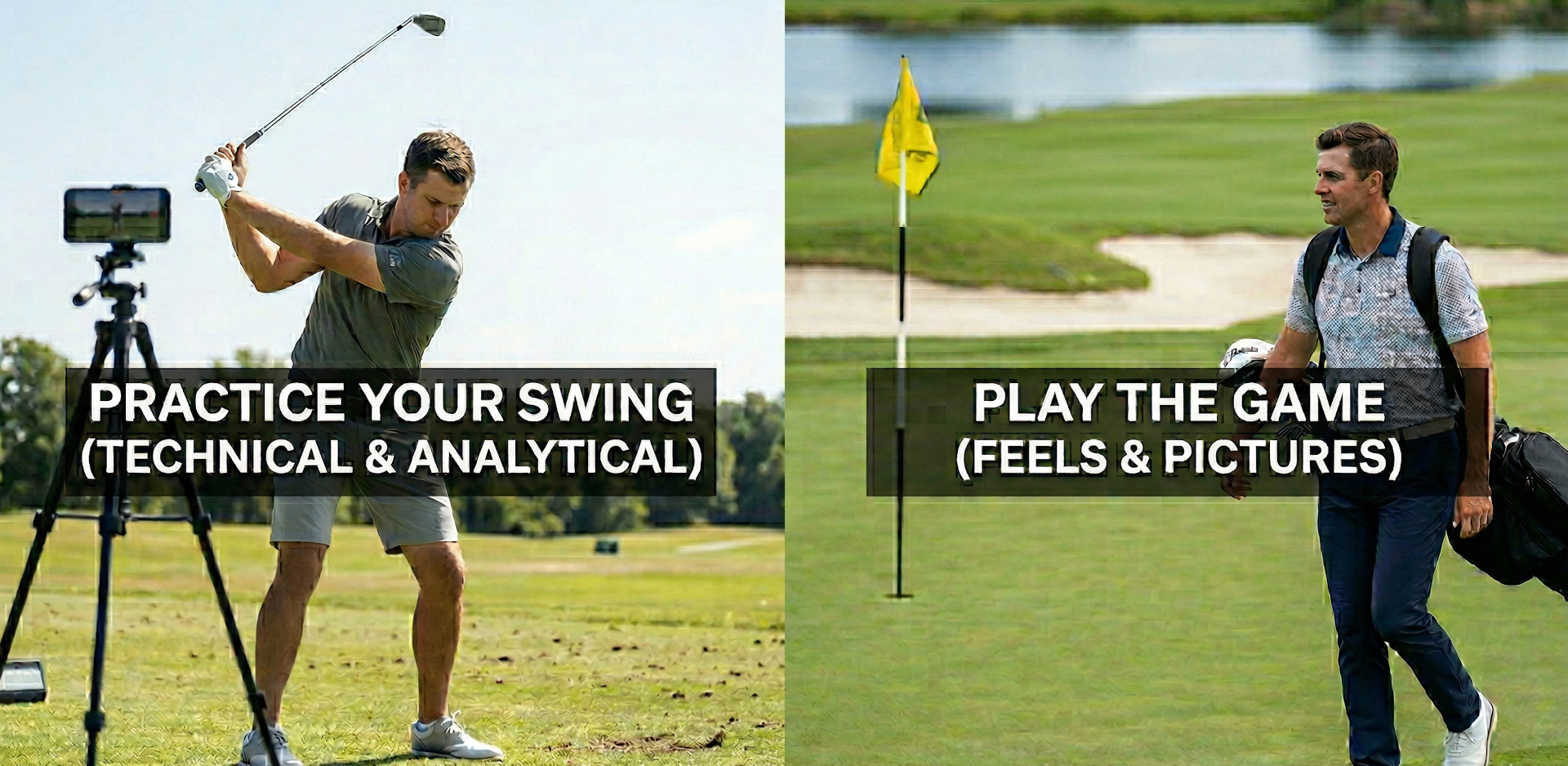
Golfers need to learn to wear two very different hats: the Technique Hat and the Play Hat.
Both are important. Both are necessary. But they have completely different jobs.
And one of the easiest ways to play worse golf is to wear the wrong hat at the wrong time.
The Technique Hat
When you put on your Technique Hat, your goal is to change or improve the movement.
This is the hat you wear during a lesson or during a specific practice session.
You might be working on:
- Your grip or setup.
- How the club moves in the backswing.
- Your pressure shift.
- Your sequencing.
- Clubface control.
- Your impact position.
- Your follow-through.
When you are wearing the Technique Hat, it is completely acceptable to think about your swing.
In fact, that is the point.
You are trying to create a movement that may not yet feel natural.
You might exaggerate something. You might hit the ball poorly while learning it. You might make slow swings or rehearsals without even caring where the ball goes.
During technique practice, the quality of the movement can be more important than the result of the shot.
If we are trying to change the way your body moves and you hit a bad shot while making the correct new movement, that can actually be a successful rep.
This is where golfers often become confused.
They hit a bad shot and immediately assume: That did not work.
But if you are changing a movement you have made for years, the ball flight is not always going to improve immediately.
Learning takes time.
Need clarity on which movement actually matters most? Start with a Game Evaluation in Austin.
Learn More →The Play Hat
The Play Hat is completely different.
When you put this hat on, your job is no longer to build your golf swing.
Your job is to play golf.
You have a target. You have a lie. You have wind. You have trouble. You have a score.
You have to decide what shot to hit and then find a way to get the ball around the golf course.
The questions are no longer:
- Where is my trail elbow?
- Did I shift enough pressure?
- Was my club on plane?
Instead, the questions become:
- Where is my target?
- What is the smartest shot?
- What is the ball likely to do from this lie?
- Where is the best place to miss?
- What club gives me the best chance of completing the shot?
That is playing golf.
Your attention should move away from your body and toward the shot in front of you.
The Range Can Have Both Hats
Here is where it gets interesting.
You can wear both hats during the same practice session.
You might spend 20 minutes in Technique Mode working on a specific movement. You might make rehearsals, hit half shots, use feedback, check video, and make another adjustment.
Then you need to change hats.
- Pick a target.
- Change clubs.
- Go through your normal pre-shot routine.
- Imagine you are on the golf course.
- Hit one shot.
- Accept the result.
- Move on.
Now you are practicing playing golf rather than practicing your swing.
Good practice should eventually move from movement to shot to target to game.
The closer you get to playing, the less technical your thinking should become.
The Golf Course Is Not a Driving Range
This is one of the most common mistakes I see.
A golfer has a lesson on Wednesday. We work on something technical. They understand it. They practice it.
Then Saturday arrives.
They stand on the first tee and immediately start thinking: Okay, keep my chest down, pressure into my right heel, do not let the club get inside, then rotate through.
They are standing on a golf course wearing their Technique Hat.
Now they are trying to consciously control a movement that takes less than two seconds while simultaneously trying to hit a golf shot.
Usually, neither goes particularly well.
The golf course is not the place to rebuild your swing.
It is where you find out how well the swing you have been building performs.
Your Swing Does Not Need to Be Perfect to Play Good Golf
This is another important lesson.
You do not need your swing to feel perfect before you can play.
Some days your swing will feel fantastic. Some days it will not.
Golfers who play well learn to compete with whatever swing showed up that day.
Maybe the ball is fading slightly more than normal. Fine. Aim differently.
Maybe you are hitting the ball a little lower. Fine. Use it.
Maybe you are not striking your irons perfectly. Fine. Choose conservative targets and rely on your short game.
Playing golf is about solving problems, not demonstrating perfect technique.
Want help turning swing work into better scores? See our developing golfer coaching in Austin.
Learn More →Do Not Try to Fix Every Bad Shot
A bad shot on the golf course does not automatically mean your swing needs fixing.
Golf contains variability. You are going to hit poor shots. Tour professionals hit poor shots.
After a bad shot, your first reaction should not be: What did I do wrong with my swing?
It should be: What do I need to do on the next shot?
Technical analysis can happen later.
The golfer who constantly diagnoses their swing during a round usually gets pulled deeper and deeper into mechanical thinking.
One bad shot becomes a swing thought. The swing thought becomes two swing thoughts. Two swing thoughts become four.
And by the back nine, they are trying to operate their golf swing like they are flying a helicopter.
There Is a Time to Analyze
After the round, we can put the Technique Hat back on.
That is where your statistics, patterns, and observations become useful.
- Did you repeatedly miss the ball left?
- Were your wedges consistently long?
- Were your drives starting right?
- Did a technical pattern we have been working on show up repeatedly?
Now we have information.
We can take that information back into practice and decide what actually needs attention.
The cycle should look something like this: Practice, play, observe, learn, practice again.
Not: practice, play, panic, change swing, change swing again, get completely lost.
One More Hat: The Competitive Hat
There is actually a third hat worth learning to wear: the Competitive Hat.
This is when the score matters.
A tournament. A club championship. Trying to break 80 for the first time. A match against your friends.
Under pressure, the goal becomes even simpler: find a way to get the ball into the hole.
You are not trying to produce your prettiest golf swing. You are trying to produce a score.
That may mean hitting a three-quarter driver. It may mean aiming 20 feet away from the flag. It may mean using your favorite club whenever possible. It may mean accepting that your swing does not feel good and competing anyway.
Great competitors are not necessarily the golfers whose swings always feel perfect.
They are the golfers who can separate how the swing feels from what the game requires.
Learn to Change Hats
A big part of becoming a better golfer is learning to recognize which hat you are currently wearing.
When you are working on your mechanics, be technical. Be patient. Exaggerate. Learn.
When you are practicing playing, choose targets, change clubs, go through your routine, and react to the shot.
When you are on the golf course, see the shot, make the decision, commit, and play.
And when you are competing, stop judging your swing and find a way to score.
The goal of golf instruction is not to create a golfer who understands every detail of their golf swing while they are playing.
The goal is to do the technical work well enough in practice that, eventually, you do not have to think about it when it matters.
Build your swing while wearing the Technique Hat. Then take it off. Put on your Play Hat. And go play golf.
Frequently Asked Questions
What is the difference between the Technique Hat and Play Hat in golf?
The Technique Hat is for changing or improving movement during lessons and focused practice. The Play Hat is for choosing targets, clubs, shot shapes, and smart misses on the course. Technique practice judges movement quality. Playing judges whether you can get the ball around the course with commitment and strategy.
Should I think about my golf swing during a round?
Usually, no. During a round, keep technical thoughts minimal and move your attention toward the shot in front of you. Choose a target, decide the smartest shot, commit to it, and play. Technical analysis is more useful after the round or during a dedicated practice session.
Why do I hit it better on the range than on the course?
Many golfers hit it better on the range because they stay in technical practice mode instead of switching into playing mode. The range allows repetition, feedback, and rehearsal. The course adds target selection, lie, wind, trouble, score, and pressure. Those require a different focus.
How do I practice golf so it transfers to the course?
Start with technical reps, then switch into performance reps. Pick a target, change clubs, use your normal pre-shot routine, hit one ball, accept the result, and move on. Good practice should move from movement to shot to target to game.
What should I do after a bad shot on the golf course?
Do not immediately try to fix your swing. First, decide what the next shot requires. Save technical analysis for after the round, when you can look for repeated patterns instead of reacting to one bad swing.
Where can I work on swing changes and course strategy in Austin?
ATX Golf Performance coaches golfers at 206 Wild Basin Road South, Building A, Suite 103, in West Lake Hills. Lessons use radar launch monitor data, 3D motion capture, and clear practice plans so you know when to work on technique and when to play.