Golf Pre-Shot Routine: A 6-Step Framework to Commit and Score Lower
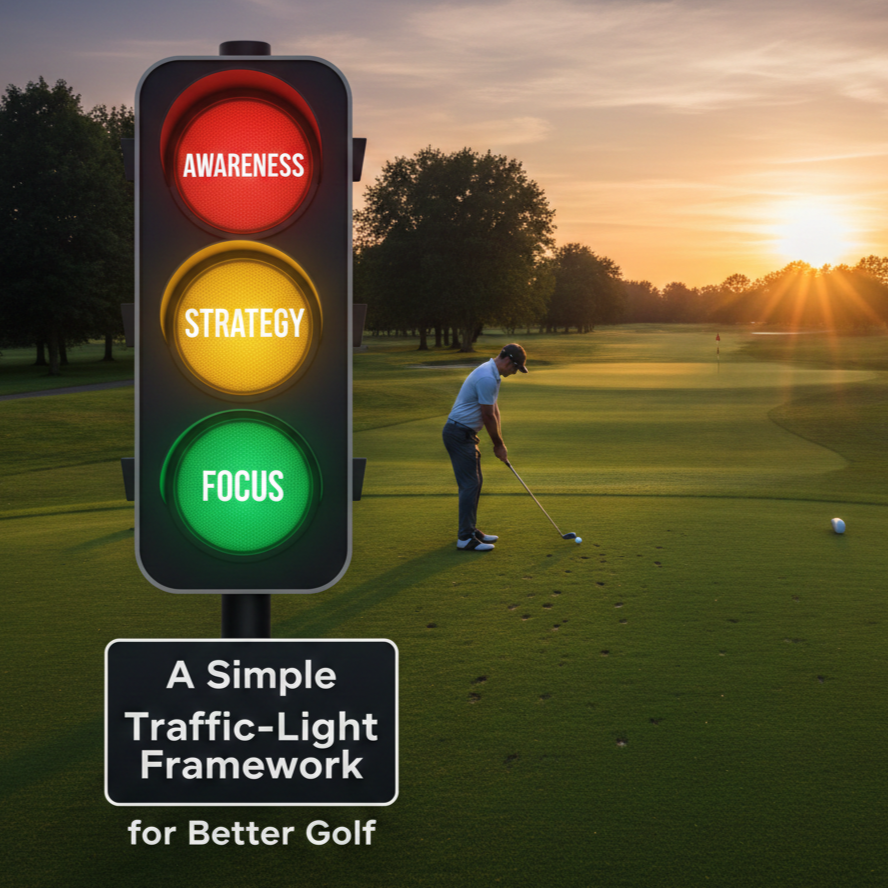
One of the most important skills you can develop as a golfer is a consistent shot routine. A good routine helps you slow down, make better decisions, commit to your plan, and learn from every shot you hit. It is not just something to do before the ball is struck. It is the process that lets you play with more intention under real pressure.
Below is the 6-step pre-shot routine I teach at ATX Golf Performance in Austin, plus how to actually use it on the course this week.
Want a coach to build this routine into your game on the course? Start with a Game Evaluation in Austin.
Learn More →Why a Pre-Shot Routine Matters
When you watch tour players, the swing looks like the highlight. The real work happens in the 20 seconds before. Touring pros use a near-identical routine on every shot, in every round, in every event. That repeatability is what lets them perform the same skill under wildly different stress levels.
For most amateurs, the opposite is true. Easy shots get a slow, thoughtful approach. Hard shots get rushed. Pressure shots get over-analyzed. A routine fixes that gap by giving you one consistent process for every shot, no matter what is on the line.
The 6-Step Pre-Shot Routine
1. Gather information
Before you choose a shot, take in the details. Look at the lie, the wind, the distance, the slope under your feet, the target, the hazards in play, and where the best miss lives. Good decisions start with good information. If you skip this step, you are guessing.
2. Make a decision
Once you have the information, choose the shot. Pick your club, your target, your trajectory, and your intended shape. The goal of this step is to move out of thinking mode and into committing mode. The decision is locked in before you take the club back.
3. Rehearse your shot
Make one rehearsal that matches the shot you are about to play. Feel the swing, the tempo, the finish, or the specific movement you want. This is your chance to connect the plan to the motion. A vague practice swing is wasted. A rehearsal that mirrors the actual shot is gold.
4. Get set up
Step in with purpose. Aim the clubface to your target first, then build your stance to the clubface. Check your posture, settle your grip pressure, and put your attention on the target. Your setup should support the shot you already chose. If your setup contradicts your plan, the swing will too.
5. Play the shot
Once you are set, trust the routine and swing. At this point, the goal is not to keep analyzing. The goal is to execute the plan you made in steps 1 through 4. Most amateurs ruin good preparation by adding a new swing thought at the top of the backswing. Commit, then swing.
6. Observe and learn
After the shot, watch what happened without judgment. Did the ball start where you intended? Did the curve, contact, distance, and trajectory match the plan? Use the result as feedback, not as a reason to react emotionally. Every shot is data for the next one.
If the same misses keep showing up, a Game Evaluation will tell you exactly why and what to work on first.
Learn More →How Long Should the Routine Take?
Total time from "I am next" to "the club is moving" should land around 20 to 30 seconds. Steps 1 and 2 happen while others are playing. Steps 3 through 5 happen once it is your turn. If your routine balloons past 45 seconds, you are not adding clarity, you are adding doubt.
How to Practice Your Routine Off the Course
A routine you only use on the course will never hold up under pressure. Build it in practice. On the range, every third ball gets a full 6-step routine. On the putting green, every meaningful putt gets a real read, a real rehearsal, and a real commitment. The body learns what the practice rewards.
Inside our studio in Suite 103, we use radar launch monitor data and 3D motion capture to make this real. You can see exactly when a rushed routine produces worse start lines, worse strike, and worse dispersion compared to a fully committed routine. The numbers move when the process is right.
Adapting the Routine for Different Shots
The 6 steps stay the same, but the content changes:
- Driver: information is wind and which side of the fairway you want, decision is shape and target line, rehearsal is tempo.
- Approach iron: information is distance, lie, and pin location, decision is club and miss side, rehearsal is finish position.
- Wedge from 60 yards: information is lie and landing spot, decision is trajectory, rehearsal is the length of the back swing.
- Putt: information is read and speed, decision is start line, rehearsal is the stroke length for that distance.
Want help wiring this routine into your real game? Book a Single Digit Golfer lesson in Austin.
Learn More →Your Homework This Week
Pay attention to your routine. Do not rush into shots. Gather information, make a decision, rehearse, set up, play, and then learn from the result. The best players are not perfect. They are consistent in how they prepare, commit, and learn. Train the process, and the outcomes will improve over time.
Frequently Asked Questions
What is a pre-shot routine in golf?
A pre-shot routine is the repeatable process a golfer uses before every shot to gather information, choose a shot, rehearse it, set up, and execute with commitment. A good routine takes 20 to 30 seconds and is the same on every shot, regardless of pressure.
How long should a golf pre-shot routine take?
Most effective routines take 20 to 30 seconds from when you step into the shot to when the club starts back. Information gathering happens while others play. Anything longer than 45 seconds usually adds doubt instead of clarity.
Do tour pros use the same pre-shot routine on every shot?
Yes. Touring professionals are remarkably consistent with their pre-shot routines, often identical in length and sequence on every shot in every round. That repeatability is one of the biggest separators between elite and amateur golfers.
What is the difference between a pre-shot routine for putting and full swing?
The structure is the same: gather, decide, rehearse, set up, play, learn. The content changes. Putting emphasizes read and speed in the information step, and the rehearsal mimics the stroke length for that exact distance instead of a full tempo feel.
How do I stop overthinking on the golf course?
Move the thinking into a structured pre-shot routine and end the thinking before you address the ball. Once you are set up, your only job is to execute the plan you already made. New thoughts at the top of the backswing are the main source of on-course overthinking.
Where can I work on my pre-shot routine with a coach in Austin?
ATX Golf Performance coaches indoors at 206 Wild Basin Road South, Building A, Suite 103, in West Lake Hills. We use radar launch monitor data and 3D motion capture to show you exactly how routine quality affects start line, strike, and dispersion.